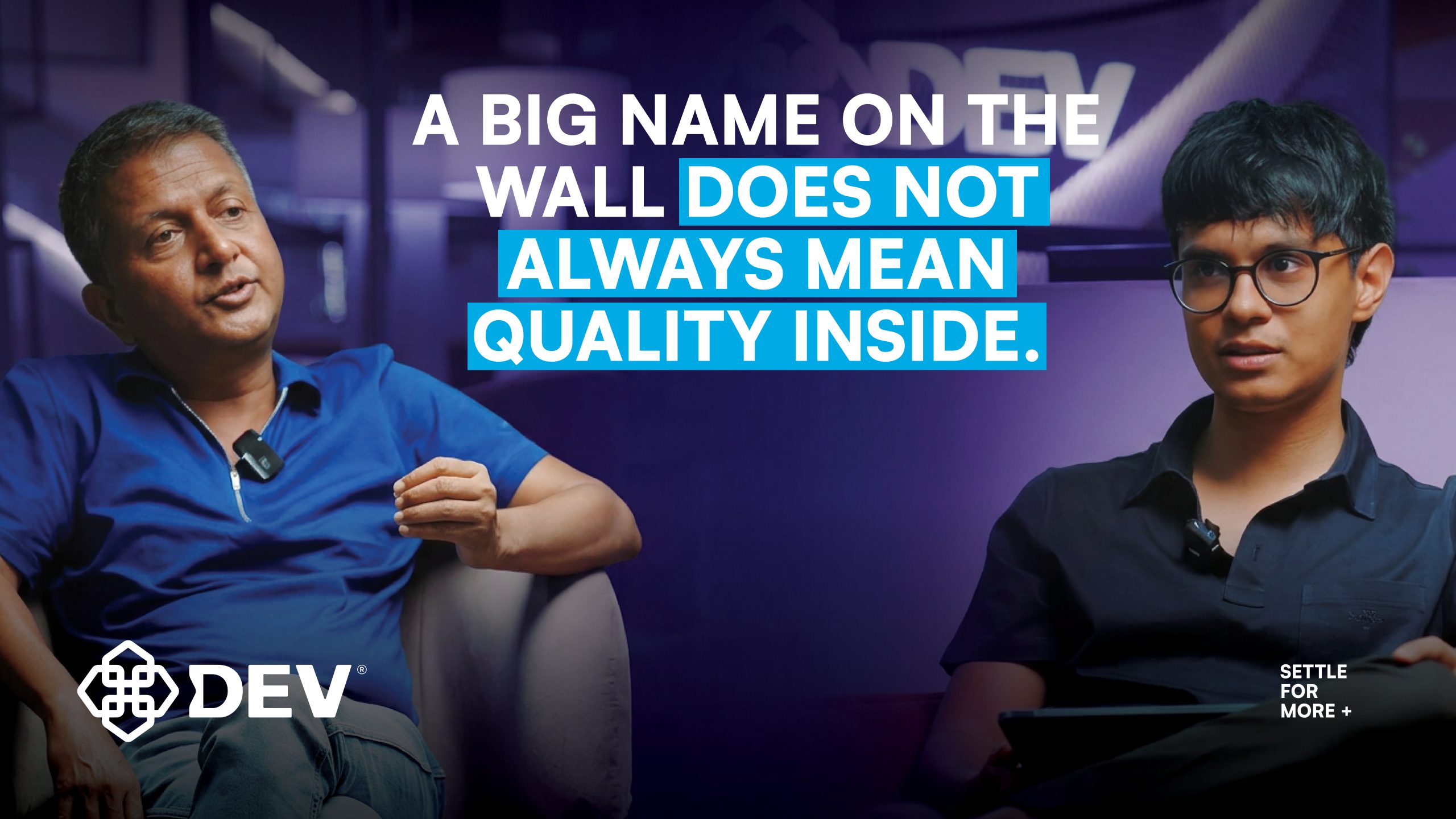
When homebuyers compare DEV Signature One with national brands, the conversation often begins with trust, scale, and reputation. But should a buying decision end there?
In this conversation, Sanjay Kumar Bansal (Managing Director, DEV Developers) joins Devansh Bansal to discuss how buyers can move beyond brand perception and evaluate projects based on specifications, usable space, and overall value.
A few key moments that set the tone for the conversation:
• Why brand reputation should be weighed alongside construction specifications, materials, finishes, and in-unit features
• How a line-by-line comparison of published specifications can help buyers make more informed decisions
• What common area loading means, and why it can significantly affect the actual usable area a homeowner receives
Watch the full interview to hear Sanjay Kumar Bansal’s perspective on comparing national brands, evaluating specifications, and understanding value beyond marketing claims.
Devansh Bansal:
Sir, a lot of prospects are asking my team, why should I buy from DEV when there are national brands selling in the same market?
These are not small brands we are being compared with. These developers are using Mivan construction. They are priced similarly or slightly above what we are pricing. They are claiming multiple amenity spaces similar to what we are giving.
So what is your answer to this question?
Sanjay Kumar Bansal:
Very good question.
From the customer’s point of view, if they are looking at a project in the initial stage of construction, I would say they have a very high level of trust in a national brand, so definitely they might get inclined towards it.
But in this particular project, since we are already at a 70% stage and we are going to hand over the first phase in 6 months and the second phase in another 6 months, the customer has to see what surplus they are getting in a national brand versus my brand.
I always tell my customers to go and see my existing delivered projects. What was the price at completion, and 3 years or 4 years down the line, what is the appreciation?
Then go to any national brand project and see what was the price at delivery and what is the price 3 to 4 years later.
I’ve personally gone to Bangalore to see one of the national brands and their huge projects.
I tell the client, if you are serious about buying a flat worth ₹2 crores, take a flight to Bangalore and see those national brands. If you like that kind of huge community, then you should go there.
But if you want premium specifications with everything I am providing inside the flat, outside the flat, and many out-of-the-box features that provide value for money, then definitely you should go for DEV.
Look at any DEV project completed in the last 25 years. What was the price at completion and what was the price after 3 to 5 years?
Then you will have an apples-to-apples comparison.
Devansh Bansal:
One more thing you’ve always mentioned is that the real difference shows up inside the unit itself.
The flooring, the electrical load, the windows, the fittings.
Are we now in a position to put that comparison in front of a prospect on paper, specification by specification?
Sanjay Kumar Bansal:
Exactly. That’s what my Experience Center talks about.
We have made it like an international museum. Everything is crystal clear, displayed, touch-and-feel.
You can see what a national brand is giving. They are giving UPVC windows at less than ₹300 per square foot. I am giving aluminum windows at ₹1000 per square foot.
The volume is also more, not just the price.
We are using green materials throughout. We are much more than IGBC Platinum rated.
That’s the verdict.
Everything inside—from the tiles to the grouting.
Somebody came and told me that a big Hyderabad brand was giving Italian marble. I had to personally go and see it.
It was not Italian marble. It was the same tiles, and they had not grouted them properly. They had only joined the edges, and that’s what leads to leakage.
One-third of my customers are NRIs. I don’t have to explain these things to them. They understand that we are following international standards.
Whether it is plumbing, waterproofing, or the way DPC beds are being installed.
We are Immediate Occupancy compliant.
There are less than five projects in Hyderabad where, if an earthquake happens, the structure is classified as Immediate Occupancy. It does not need another OC from GHMC. All of this is reviewed by IITs.
Devansh Bansal:
My next question was going to be what the buyer is actually getting inside the unit at this price point, but it looks like you’ve already answered that.
What would you say are your top three reasons—or top three specifications—where you outperform the market?
It could be specifications, finishes, ceiling heights, or anything else.
What would be your top three reasons?
Sanjay Kumar Bansal:
If I talk percentage-wise, the amenities as per GHMC standards are supposed to be 3%.
I am giving more than 10%.
In a 3.5-acre community, somebody may want the same specifications that another developer is giving in a 10-acre project.
I am giving those specifications for 300 families. Others are giving them for 900 families.
So that’s one major amenity advantage.
Apart from that, when you look inside the apartment, my balconies are larger and my glass railings are different. Most others are using MS railings.
I am providing water metering.
I would bet that nobody else is water metering a 4 BHK.
You may have one family with 3 to 4 people and another with 8 to 10 people staying in it.
We are trying to ensure life is simple not only at the buying stage but also later at the maintenance stage.
I have stacked parking.
Nobody is giving stacked parking as a bonus. It is not calculated in the parking allocation.
Now, because fuel prices are surging, I think one of the biggest reasons people should buy is EV charging.
I was told the all-India standard is 10%.
I am giving 50%.
For every two flats, I am providing one dedicated EV charging point between them in their permanent parking slot.
It is not the variable charging cost that matters. It is the infrastructure that I have created.
To support that, I have to provide a much larger transformer and generator capacity.
I think these are a few points that differentiate us.
Devansh Bansal:
I have to agree with you, especially on your point about EV charging.
I actually feel you’ve understated the market situation when you said 10% is the standard.
I know projects in the same location that are providing under 5% EV charging capacity.
Projects with around 4,500 units have provided fewer than 20 to 30 EV charging points.
Very good to know that we are following all these standards and providing these premium features.
Sir, one question that has always troubled me, and something my team constantly faces with clients, is common area and loading.
Different people, different developers, and different clients perceive this point in different ways.
What exactly is loading?
What is markup?
What is markdown?
Where do we stand, and where do you think the market is right now?
Sanjay Kumar Bansal:
I’ve been trying to educate my sales team on this.
I’ve been a developer since 1998.
RERA came around 5 to 7 years back.
RERA is very simple.
Whatever you get sanctioned by GHMC, that is what you should sell.
Our sanction is 8,27,000 square feet.
That includes Tower 1, Tower 2, and the clubhouse tower.
That much area should be sold.
When we calculated our common area, it came to 23% markdown.
When you convert that into markup in an architect’s language, it becomes 30%.
All the players, including national players on this road and other developers, are doing markdown at 30%.
They are 7% higher than us.
Devansh Bansal:
But that would mean a markup of 43%, correct?
Sanjay Kumar Bansal:
Correct.
Devansh Bansal:
So what we are giving clients is 30% common area compared to 43%.
And we are at 23% markdown whereas the market is at 30% markdown.
Sanjay Kumar Bansal:
Yes.
Clients were confused because our team was saying 30% without specifying that it was markup.
National players were also saying 30%.
Devansh Bansal:
Understood.
Sanjay Kumar Bansal:
That’s where the real gap is.
I had to explain it using Excel.
Then I told them to compare my model flat of 3,700 square feet.
Feel the spaces.
The equivalent in another brand would be around 4,300 square feet.
Devansh Bansal:
Understood.
Just to understand the actual numbers here.
People seem comfortable paying at least a 10% premium to a branded developer.
So if I am quoting ₹8,000 per square foot, a national developer should be able to demand close to ₹9,000 per square foot or ₹8,800 per square foot.
But when you factor in this common area point, the client is either paying at least 10% to 15% more, or paying the same amount and getting 10% to 15% less.
So if they are getting a 2,000 square feet apartment from a branded developer here, then for the same price they should be able to get at least a 2,500 square feet apartment here.
Is that correct in terms of actual usable plinth or carpet area?
Sanjay Kumar Bansal:
Yes.
Devansh Bansal:
There is at least a 25% to 30% gap, which is extremely high.
Sanjay Kumar Bansal:
Yes, correct.
I would say around 20%.
There is a 7% differential in markdown on both sides, and a minimum 10% to 12% premium they are charging.
So approximately 20%.
A 2,000 square feet apartment there versus around 2,400 square feet with us.
So you are close.
Devansh Bansal:
I’m sure.
What you’re telling me is that when a building is under construction, trust plays a major role.
Will the developer deliver on time?
That is one reason customers are willing to pay a significant premium to a branded developer.
But let’s say both projects are delivered 2 years from now.
Do you think a branded developer with at least 7% higher common area will still be able to command the same 20% premium over a project like ours?
Sanjay Kumar Bansal:
That’s exactly why I want customers to go and see their existing projects.
Every national player has delivered projects somewhere—if not in Hyderabad, then in Mumbai, Bangalore, or Chennai.
See what happened 3 years after delivery.
Did it appreciate or not?
Then compare that with any of my projects delivered in the last 20 to 25 years and see what appreciation happened there.
Sanjay Kumar Bansal:
AI can answer all of this now for customer convenience and ease.
I tell every customer, and everyone in my organization, that whatever I am saying, just put it into AI.
This is the national brand, this is the price they are quoting.
This is the DEV brand, this is the price.
AI has all the information.
It is not biased. It is not listening to me, and it is not listening to the national brand.
Devansh Bansal:
Understood, sir.
Got it.
Very well put. Thank you.